










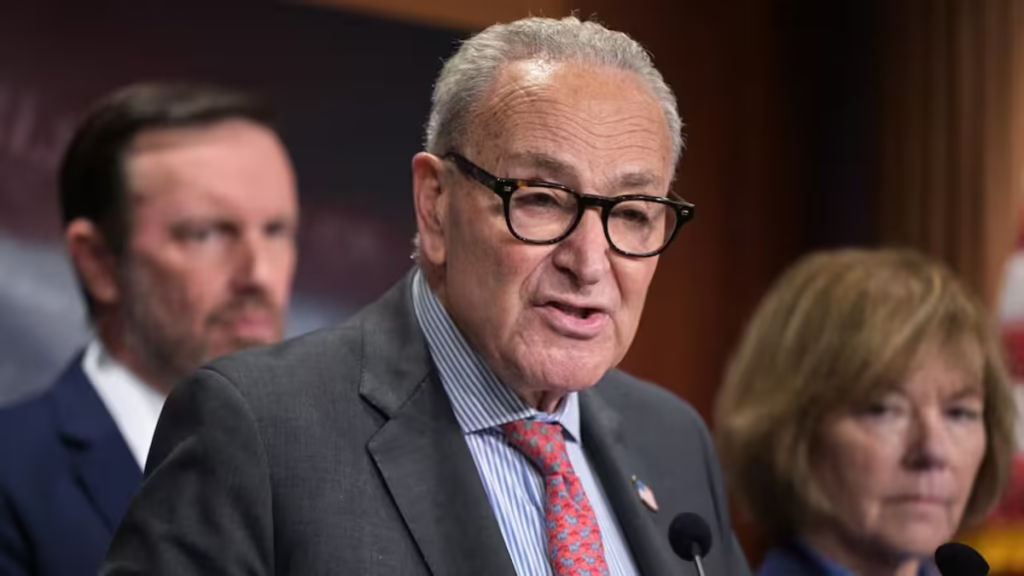
U.S. Senate Democratic Leader Chuck Schumer and his House of Representatives counterpart Hakeem Jeffries, on Saturday requested a meeting with President Donald Trump to prevent a government shutdown when funding expires on September 30.

Writing a letter to Trump, Schumer and Jeffries stated Republican congressional leaders had time and again and in public declined to sit for bipartisan talks to keep the government running as instructed by the president.
Medical care is also at the center of the battle over funding with Democrats calling for additional money for subsidies under the Affordable Care Act and restoring funding taken away from the Medicaid healthcare program for lower-income Americans.
“Democrats have been clear and consistent in our stance. We stand ready to negotiate a bipartisan spending deal that enhances the American family’s life and responds to the Republican healthcare crisis,” Schumer and Jeffries said.
“But we will not vote for a dirty spending bill perpetuating the Republican attack on healthcare.”
The Senate on Friday voted down a short-term spending bill and then adjourned for a week-long recess, making a shutdown more likely.
US senators ask trump to negotiate as government shutdown approaches
Congress has had difficulty approving spending bills in recent years as party tensions have mounted, threatening a shutdown that would leave government employees without pay and a broad array of services unavailable.
With the September 30th deadline looming, Republicans will be responsible for yet another agonizing government shutdown due to the GOP congressional leadership’s refusal to even negotiate with Democrats,” the two leaders wrote.
“As such, it is now your duty to sit down with us to come to an agreement to keep the government open and end the Republican healthcare crisis.
Alternatively, US President Donald Trump on Saturday directed an annual $100,000 fee to be imposed on H-1B skilled worker visas, potentially having significant implications for the tech sector where such visas are rampant.
The new provision, which would most likely be contested in court, came as part of the unveiling of a $1 million “gold card” residency program that Trump had announced several months ago.
“The main thing is, we’re going to have great people coming in, and they’re going to be paying,” Trump told reporters as he signed the orders in the Oval Office.
What is H-1B skilled worker visa
H-1B visas allow companies to sponsor foreign workers with specialized skills — such as scientists, engineers, and computer programmers — to work in the United States, initially for three years, but extendable to six years.
Indians to be hit hardest
The United States hands out 85,000 H-1B visas annually on the basis of a lottery, and three-quarters of these go to Indians.
India provides big tech companies with Indian employees who leave their native country or move back and forth between the US and India.
Technology business leaders — such as Trump’s former partner Elon Musk — have cautioned against singling out H-1B visas, indicating that the United States lacks sufficient domestic talent to occupy critical tech industry job openings.
“All the big companies are on board,” said Commerce Secretary Howard Lutnick, who accompanied Trump to the Oval Office.
Trump has targeted the H-1B program since his early days in the White House, but was thwarted by court challenges to his initial strategy, which aimed at the categories of jobs that were eligible. The latest version has become the latest action in the sweeping immigration crackdown of his second term.
Read More: Trump sees progress on TikTok, says will visit China
Under Trump’s directive, the fee will be mandatory for individuals applying to enter the country starting Sunday, with the Homeland Security secretary having discretion to exempt individuals, entire businesses, or entire sectors.
The directive comes up for renewal in one year, although Trump can renew it.
Applications for H-1B visas have increased sharply over the past few years, with a record of approvals being set in 2022 under Democratic president Joe Biden.
By comparison, the highest rejections were tallied in 2018, Trump’s first year in the White House.
The United States granted about 400,000 H-1B visas in 2024, of which two-thirds were renewals.
Trump also signed a directive establishing a new expedited route to US residency for individuals who pay $1 million, or for corporate sponsors to pay $2 million.
“I think it’s going to be tremendously successful,” Trump said.