







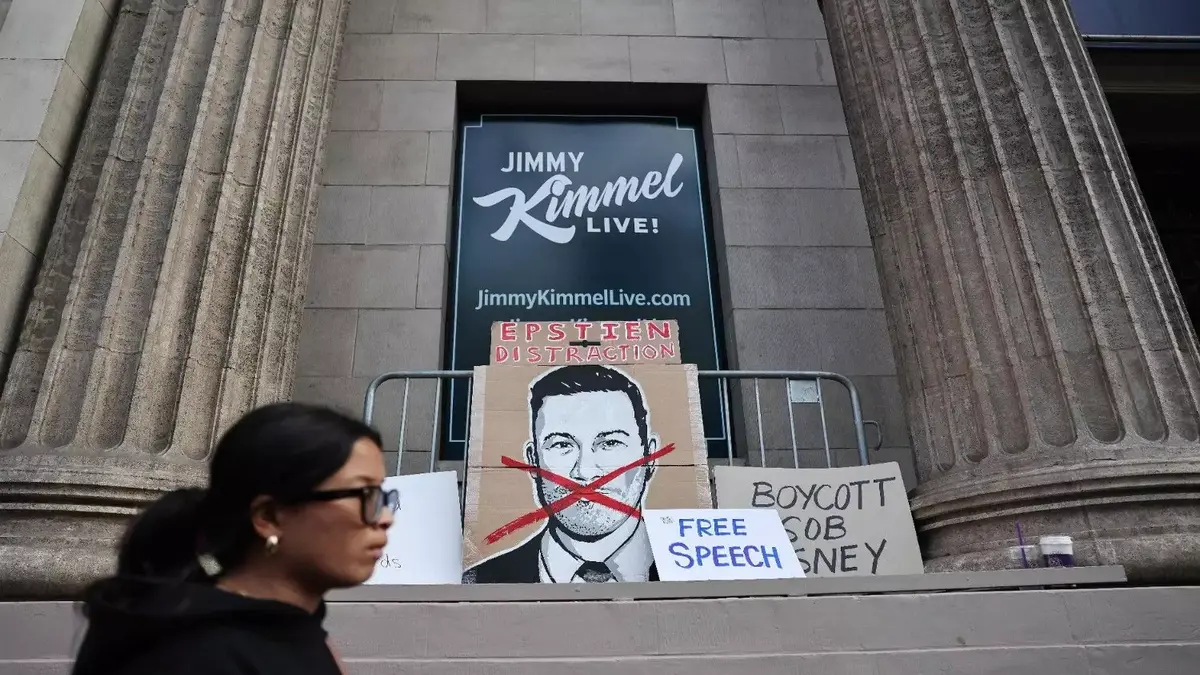
The phrase “First Amendment to the US Constitution guarantees freedom of speech” is sacred to Americans
For Americans, the phrase is virtually sacred: the First Amendment to the US Constitution guarantees freedom of speech.
But that freedom is now under acrimonious debate, in the aftermath of the assassination of right-wing campaigner Charlie Kirk.
On Thursday, a number of senior Democrats charged President Donald Trump with declaring war on free speech, following his celebration of ABC suspending talk host Jimmy Kimmel, who blamed the political right for politicizing Kirk’s death to gain points.
The American Civil Liberties Union, an advocacy group for rights, blamed the Trump administration for acting outside constitutional protections to attack its adversaries, in what it compared to the Red Scare of the late 1940 and 1950s during senator Joseph McCarthy.
“This is McCarthyism on steroids. Trump officials are repeatedly misusing their authority to prevent ideas they don’t agree with, determining who gets to speak, write, and even joke,” said Christopher Anders, head of the ACLU’s democracy and technology unit.
So what does the First Amendment state? And why is it being debated?
How we identify ourselves
Signed into law in 1791, the Bill of Rights are the first 10 amendments to the US Constitution, guaranteeing the basic rights of Americans.
“Congress shall make no law respecting an establishment of religion, or prohibiting the free exercise thereof; or abridging the freedom of speech, or of the press; or the right of the people peaceably to assemble,” reads the First Amendment.
Kirk shooting ignites bitter US free speech controversy
For Georgetown University law school professor David Super, the amendment is “really how we define ourselves as a nation.”
Beyond the diverse ethnicities and heritage of the country’s 340 million citizens, “we are believed to be brought together by a faith in open debate and a conviction that the government can’t silence any of us,” Super said to AFP.

The First Amendment even safeguards speech that is “morally repulsive,” said Eugene Volokh, a law professor at the University of California, Los Angeles.
Volokh nonetheless asserted that United States history has been filled with attempts to silence dissident voices.
‘Malicious writings’
Then in 1798, John Adams, the second president of America, signed the Sedition Act into law, prohibiting “any false, scandalous and malicious writing or writings against the government of the United States.”
Later during World War I, the pacifist ideology was prohibited from expression.
From the 1920s to the 1950s, to show approval of communist doctrine meant facing serious consequences. And in the 1960s, authorities in a number of southern US states fought to muzzle the civil rights movement.
One of the founding pillars of Trump’s political movement has been to dismantle “cancel culture” — the process of condemning someone for speaking out on something deemed unacceptable, to the extent of that individual being shunned or sacked.
Trump has regularly referred to “cancel culture” as a plague of left-wing progressives, accusing it of being employed to silence right-wing commentators and politicians.
However, Democrats have confronted Trump with his own words, accusing him of doing the same to US news organisations, top universities and, most recently, Kimmel — a consistent thorn in Trump’s side.
“Years of whining about cancel culture finally paid off for the current administration as it took it to a new and perilous height,” Democratic former president Barack Obama posted Thursday on X.
Conservative push-back
US Attorney General Pam Bondi ignited controversy among conservatives by stating earlier this week that the Justice Department would prosecute anyone who is responsible for “hate speech” associated with the slain influencer.
Republican Senator Ted Cruz immediately rebutted that the Constitution “absolutely protects hate speech.” Bondi then clarified that she was trying to speak about “threats of violence that individuals incite against others.”
Conservative TV host Tucker Carlson urged “civil disobedience” should Kirk’s murder lead to an increase in laws constraining free speech.
And some far-right voices have denounced a decree signed by Trump in August making flag burning illegal and punishable by up to one year in prison.

In 1989, the US Supreme Court held that flag burning actually constituted free speech and was covered by the First Amendment.
“I would never in a million years burn the American flag,” conservative talk radio host Jesse Kelly posted on X.
But a president telling me I can’t puts me about as close as I’ll ever get to burning one. I am a free American citizen. And if I ever get the urge to burn one, I will.