





The United States, Europe, and allies have imposed more than 25,000 different sanctions on Russia over the 2022 war in Ukraine and the 2014 annexation of Crimea in a bid to sink Russia’s $2.2 trillion economy and undermine support for President Vladimir Putin.
Washington has also hit India with tariffs in response to New Delhi’s oil trade with Russia.
Putin claims the economy of Russia has exceeded projections. It increased at a higher rate during the last two years than the G7 nations, defying Western forecasts of an economic collapse. He has instructed companies and officials to ignore sanctions in all possible ways.
But signs of pressure on the economy are increasingly evident, which the central bank now demonstrates to be technically in recession and to be suffering from high inflation.
Russia dodges Western sanctions with barter trade 2025
Some punitive measures – particularly the disconnection of Russian banks from the SWIFT payments system in 2022 and Washington’s warnings to Chinese banks last year against supporting Russia’s war effort – have stoked fears of secondary sanctions.
“Chinese banks are afraid of being placed on sanctions lists, under secondary sanctions, so they do not accept money from Russia,” a source in the payment market told Reuters.
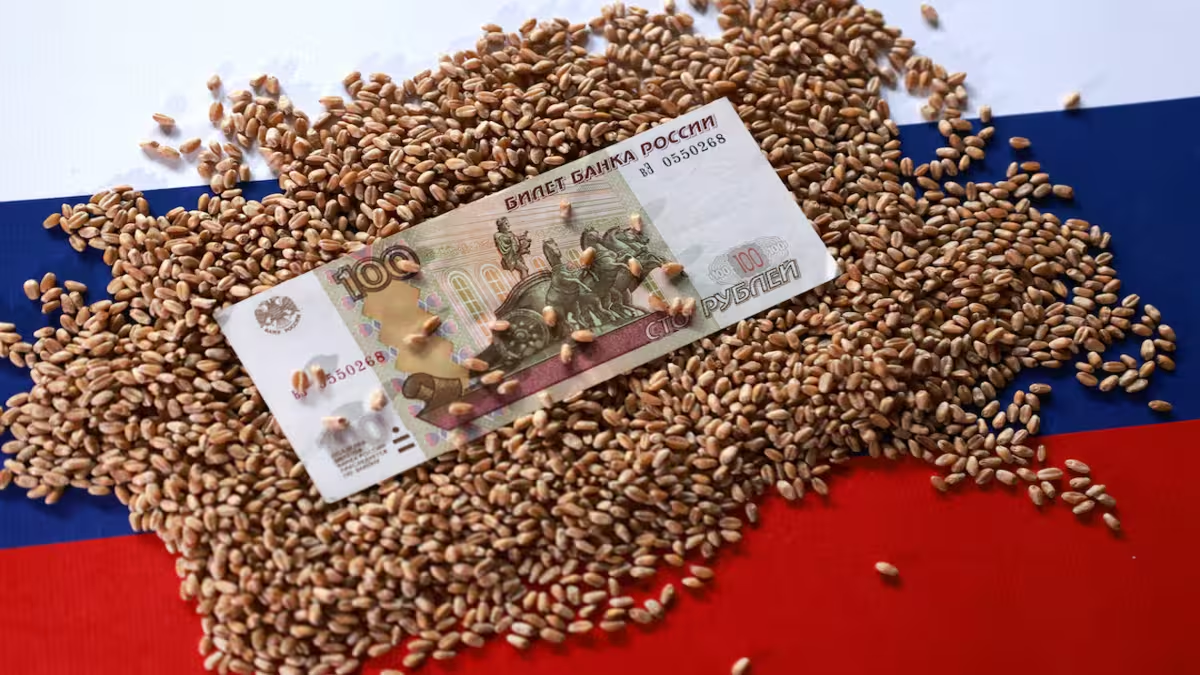
Those fears seem to lie behind the surge in barter deals, which are far more difficult to track. In 2024, Russia’s economy ministry published a 14-page “Guide to Foreign Barter Transactions,” which set out guidelines on how to employ the technique to avoid sanctions. It even suggested setting up a trading platform that would function as a barter exchange.
Foreign trade barter transactions facilitate the exchange of goods and services with foreign firms without the necessity of international transactions,” the ministry document stated, referring to “conditions of sanctions restrictions.”
Until recently, there was minimal evidence of commercial interest in such transactions. Yet last month, Reuters reported that China’s Hainan Longpan Oilfield Technology Co. was looking to exchange steel and aluminium alloys for marine engines.
The firm did not comment on a request.
Reuters, for this report, was able to find eight of such goods-in-kind transactions from trade sources, public statements by customs services as well as company remarks. The transactions were not reported before.
Though the news agency was unable to determine the total value or volume of barter in the Russian economy because the transactions are not transparent, three trading sources indicated the practice was gaining ground.
“Barter growth is a sign of de-dollarisation, sanctions pressure and liquidity issues among partners,” Maxim Spassky, General Council Secretary of the Russian-Asian Union of Industrialists and Entrepreneurs, a trade group, said in an interview with Reuters. Barter volumes were set to increase further, according to Spassky.
Russia dodges Western sanctions with barter trade 2025
One of the sources of trade – who requested anonymity because of the confidential nature of the information – said the system assisted in evading sanctions which cut Russian banks off from dollar and euro transactions.
Three analysts mentioned that a potential signal of the extent of barter was an increasing gap between the foreign trade data of the central bank and its own customs service data, reaching $7 billion for the first six months of this year.
On being asked for comment, Russia’s customs agency stated that it had conducted barter with various nations “for a broad variety of goods.” It added, however, the volume of barter trades was negligible relative to volumes of foreign trade contracts.
Russia’s foreign trade surplus in January – July fell 14% year-on-year, to $77.2 billion, as per data released by the Federal Customs Service. Imports over this period fell by $11.5 billion to $232.6 billion, while imports rose by $1.2 billion to $155.4 billion.
The government and central bank refused to comment on barter with Reuters other than to say that there was no information on such deals because they would be incorporated in the aggregate numbers if illegally reported. The data divergence might result from methodological differences, a source close to the government said.
CARS FOR GRAIN
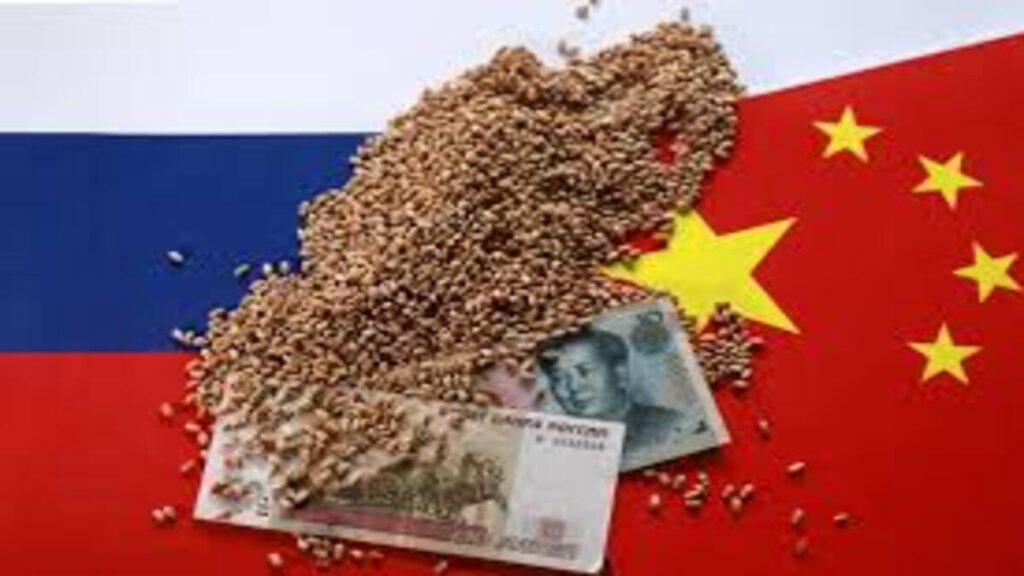
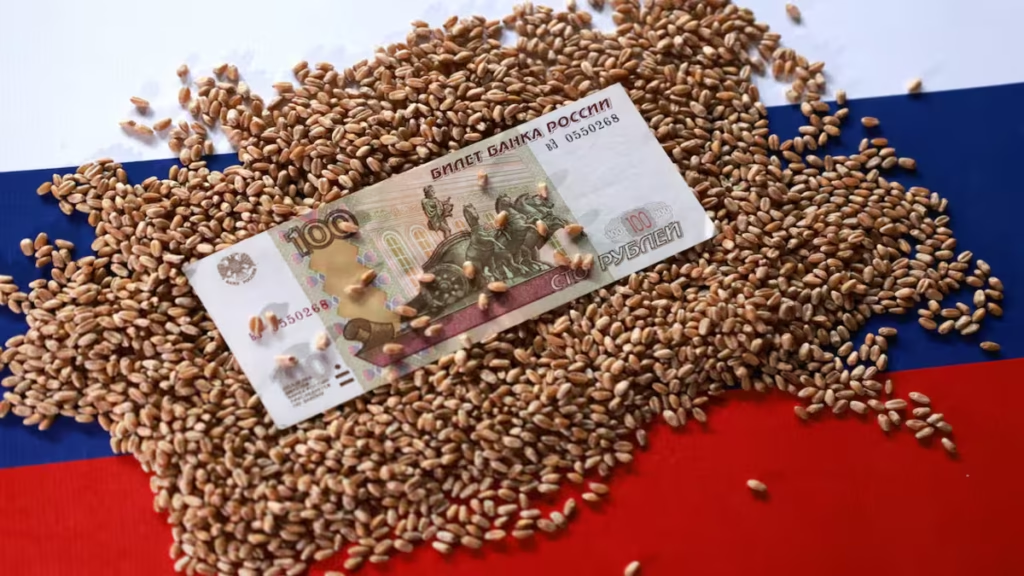
In a transaction cited by Reuters from two sources involved in trade, Chinese vehicles were exchanged for Russian wheat. The Chinese partners in the transaction requested their Russian counterparts to settle in grain, the source said.
The Chinese partners purchased the vehicles in China for yuan. The Russian partner purchased grain using roubles. Then grain was traded for vehicles.
Russia dodges Western sanctions with barter trade 2025
Reuters was unable to determine the amounts traded, or how the traders determined the value of the grain or the automobiles.
And in two other deals, flax seeds were traded for goods such as house appliances and building materials from China, customs statements reveal. Industry insiders who have acquaintance with Russia’s foreign commerce asserted that one of the flax transactions, recorded in a 2024 statement from Russia’s customs service of the Urals, is worth an estimated $100,000.
China is also a significant importer of Russian flax seed, employed in industry and as a foodstuff.
In other business dealings, metals were shipped to China in return for machinery, Chinese services exchanged for raw materials, and a Russian importer purchased aluminium to settle a Chinese company. One transaction involved Pakistan.
Certain barter deals have permitted Western goods to be imported to Russia in spite of sanctions, two sources familiar with the deals said, without elaborating on what goods.
During the Kazan Expo business forum in August, Chinese businesses cited settlement difficulties among concerns that were hampering the growth of bilateral trade. Xu Xinjing, chairman of Hainan Longpan Oilfield Technology Co., Ltd, described barter trade as a possible solution.
Addressing the conference, Xu said that “in the existing conditions of scarce payments,” barter opened up new opportunities for Russian and Asian enterprises.
BARTER SOWED CHAOS IN THE 1990S
Following the collapse of the Soviet Union in the 1990s, barter planted disorder throughout the economy as huge chains of conditional transactions were established for everything from oil and electricity to flour, sugar and boots, with pricing cons that made value difficult to quantify and yielded fortunes for a few.
Then, there was not enough money in hand, huge inflation and continuous devaluations to make barter look good. Today, there is money galore and barter is being spurred by the ever-changing pressure of the constant threat of Western sanctions on Russia and China.
Russia has termed the Western sanctions as illegal and China has criticized them as discriminatory.
Bartering is not the only solution. Payment agents are used by some traders at a fee, who arrange payments through different schemes, but such payments are risky.
Another method of making payments is through Russia’s state-owned VTB bank with a Shanghai branch. Others opt for U.S. dollar-backed cryptocurrencies.
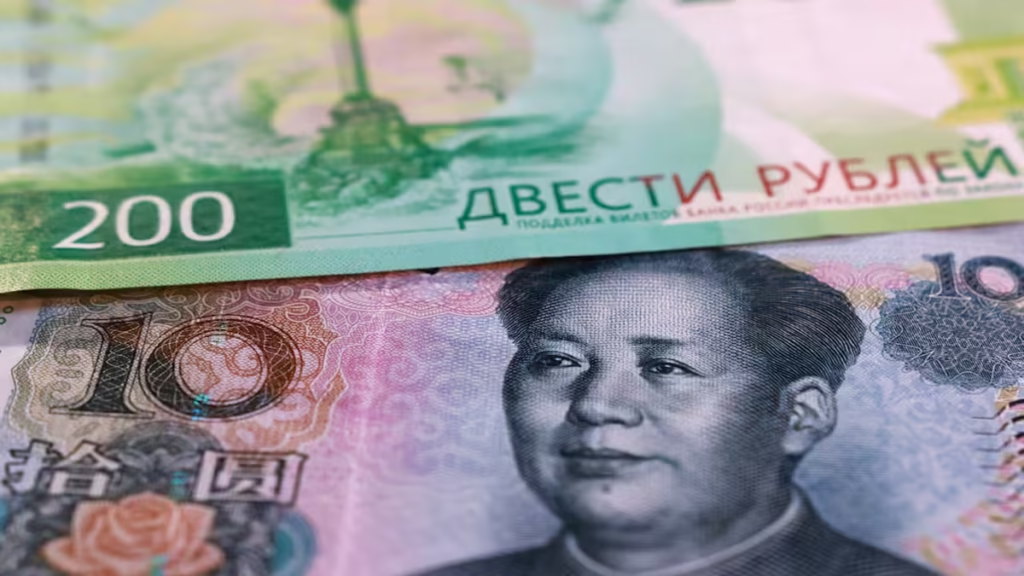
“Small businesses are actively employing crypto. Some carry cash around, some use offsets, some diversify accounts at various banks,” BCS vice president for operations and IT Sergey Putyatinsky said.
“There is no ready-made technological solution yet. The economy is holding on, and business is using 10-15 various forms of payment at the same time,” he said.